GYLD 2025 Thematic Forum I “Young Leaders’ Strategies: Innovation and Entrepreneurship Ecosystems”
November 19 , 2025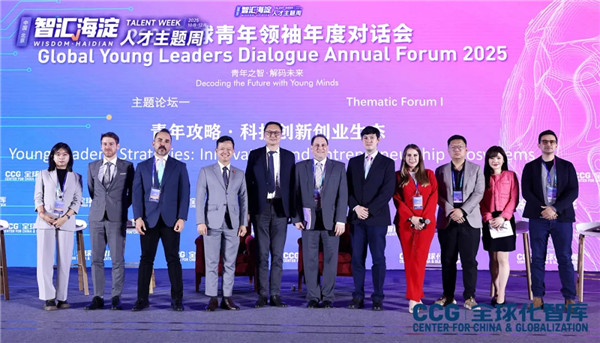
Themed “Decoding the Future with Young Minds,” the Global Young Leaders Dialogue Annual Forum 2025 was successfully held in Beijing’s Haidian District from November 18 to 20. The event was hosted by the Center for China and Globalization (CCG), co-organized by the Secretariat of the Global Young Leaders Dialogue (GYLD) program, and supported by the Haidian District Human Resources Bureau and the Haidian District Foreign Affairs Office. The Annual Forum featured two thematic forums, titled “Young Leaders’ Strategies: Innovation and Entrepreneurship Ecosystems” and “Young Leaders’ Solutions: Technology and AI Addressing Global Challenges.”
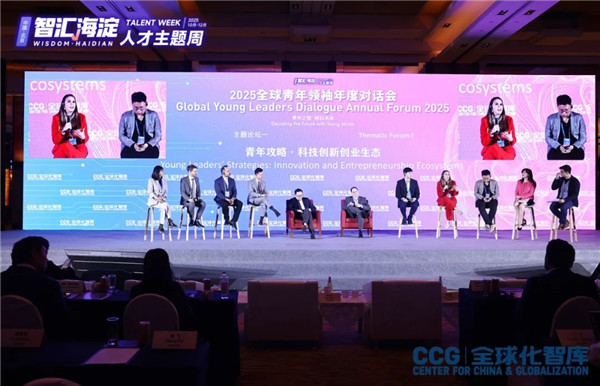
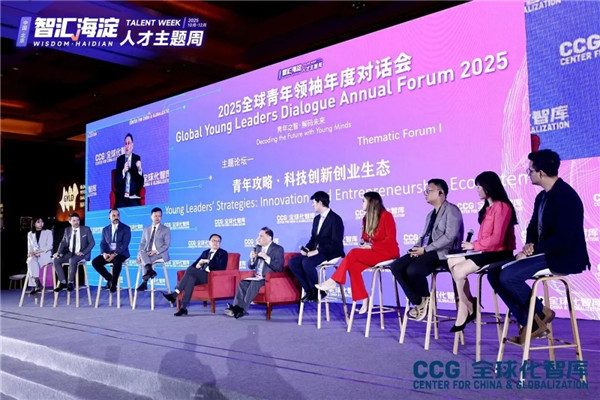
During the first thematic forum, speakers shared insights on key questions including how to define a healthy innovation and entrepreneurship ecosystem for young people, and how governments, universities, and enterprises can work in concert to support young talents’ innovation. They agreed that building an open and inclusive innovation environment requires stronger cross-sector collaboration, more effective mechanisms for technology commercialization, and policy frameworks that are genuinely youth-friendly. They also emphasized that young people should be empowered as participants, creators, and beneficiaries of the innovation ecosystem, so that innovation can truly take root through mutual learning and collaborative development among young people worldwide.
Video | Thematic Forum I “Young Leaders’ Strategies: Innovation and Entrepreneurship Ecosystems”
Inspirer
YU Teng (China), The 9th “Haiying Talent”; CEO, Thewake Systems Co. Ltd
Drawing on his experiences growing up in Haidian, studying overseas, and returning to China to launch a startup, Mr. Yu Teng illustrated the dramatic changes in China’s technology landscape. He noted that in the context of the national “AI+” strategy and the prevailing wave of technological development, the key to personal entrepreneurship lies in seizing opportunities and integrating into the fast-evolving innovation ecosystem. He encouraged international young talents to spend time in Haidian, explore, build genuine interpersonal and technological connections, and board China’s “high-speed train” of technological development to realize both personal value and shared benefits from the era’s opportunities.
Senior Expert
James B. Heimowitz (United States), Vice Chairman, Alliance of Global Talent Organizations (AGTO); Honorary Chair, China Institute of America; Founder and Director, JBH Consulting Group
With decades of experience bridging the U.S., China, and global platforms, Mr. James B. Heimowitz emphasized that innovation and collaboration are inseparable in the technological entrepreneurship ecosystem. He encouraged entrepreneurs to think beyond local markets to create solutions that transcend geographic boundaries. He highlighted the importance of enhancing human connectivity and fostering an inclusive, diverse entrepreneurship ecosystem where people from different cultures and stages of development can learn from one another.
Senior Expert
David Zhang (China), Director of Global Integration, Project Management Institute (PMI) China
Mr. David Zhang emphasized that enabling talent to thrive in an innovation and entrepreneurship ecosystem requires cultivating T-shaped skills—strong vertical depth in a core domain combined with broad horizontal breadth across disciplines. He highlighted the importance of lifelong learning in sustaining this balance, noting that organizations must support continuous skill development beyond narrow specializations, particularly in the AI era. Drawing on PMI’s global practices, he underscored how shared standards, methodologies, and a common professional language can bridge diverse markets and enable effective global collaboration.
Young Leader
Carolina Fabara (Ecuador), Post Doctoral Fellow, Sun Yat Sen University; Founder, CrossFrontier Legal Consulting
Dr. Carolina Fabara shared her experience as a young woman entrepreneur from Latin America building a business in China, emphasizing the importance of trust, information, and practical tools for foreign founders. Through her company, she bridges cultural and business gaps between China and Latin America, using legal expertise and AI to empower women and connect more women with business opportunities in China. She also highlighted the need to make laws and regulations accessible and easy to understand so that entrepreneurs can confidently navigate business processes in China.
Young Leader
Kris Mikel-Hong (United States), Assistant Professor, Department of Organization and Human Resources, Business School of Renmin University of China
Dr. Kris Mikel-Hong emphasized that successfully implementing AI in organizations goes beyond technology, requiring thoughtful organizational design and close attention to human factors. He noted that simply providing more AI tools to employees does not automatically improve performance; the key drivers are human factors, including AI literacy, thoughtful integration of AI into workflows, and structuring teams to leverage AI’s unique capabilities. For instance, having all team members use the same AI tools can lead to identical queries and outcomes. He underscored the need for a holistic approach, where individuals and teams work collaboratively and adaptively with AI.
Young Leader
Edward Lim (Singapore), Country Manager (Vietnam), Block 71 Global; President & Founder, VSync Network
Mr. Edward Lim used the English acronym “GYLD” of the Global Young Leadership Dialogue program to summarize the four key elements of a successful innovation ecosystem: G (Generosity), meaning a willingness to share knowledge, networks, and time; Y (saying “Yes”), representing an open mindset that embraces experimentation and learning from failure; L (Linkages), referring to the effective connection of research, industry, policy, capital, and global networks; and D (Do), emphasizing the importance of rapid execution, continuous iteration, and effective implementation. Drawing on his observations across different markets, he noted that founders often face challenges related to cultural norms, regulations, and language when entering new ecosystems. He shared how platforms such as Block71 help founders navigate local practices, build meaningful connections, and adapt more smoothly to new markets.
Young Leader
André Quemé (Brazil), Founder, LATAM China Tech
Mr. André Quemé emphasized that a healthy innovation ecosystem relies not only on knowledge exchange, but more importantly on human connection and interaction that can generate unexpected outcomes. As he studied in Beijing and worked across creative and tech sectors, he highlighted the need to bring together diverse actors, including universities, governments, startups, investors, and communities, to enable serendipity. He stressed the role of events, training programs, and open discussions about failure in building trust, collaboration, and shared learning. He also noted ongoing challenges for foreign entrepreneurs, such as access to information, networks, and capital, and he shared how LATAM China Tech helps bridge these gaps.
Young Leader
Alan SAAS (France), Consultant Expert in AI Applications; Founder, Merlin BI
Mr. Alan Sass described today’s AI landscape as a shift from deterministic algorithms to probabilistic models, requiring leaders to develop a new kind of AI literacy. He argued that a strong innovation ecosystem must emphasize exploration and shared learning, drawing on his experience in an incubator where openly sharing successes and failures in AI helped participants avoid working in silos. He noted that without such networks, many established companies may quickly fall behind in AI. He also advocated for ethical incentives that steer AI development toward productivity and industrial applications rather than unchecked pursuit of Artificial General Intelligence (AGI).
Young Leader
Michelle Tiong (Malaysia), Post-Doctoral Researcher (Energy Transition), Unconventional Petroleum Research Institute, China University of Petroleum
Dr. Michelle Tiong emphasized how government, universities, and industries can collaborate to strengthen the innovation and entrepreneurship ecosystem. She highlighted the crucial role of government in setting clear policy directions, which has enabled universities to confidently pursue research with sufficient funding, and she discussed universities’ efforts in developing talent and fostering industry collaboration. Working in energy transition, she noted that AI development may inadvertently increase carbon emissions, underscoring the need for innovative solutions. Beyond academia, she acts as a bridge between Malaysian companies and Chinese investors, promoting collaboration over competition and helping companies navigate policies and opportunities in China.
Moderator
Wahed Ahmadzai (Afghanistan), Secretary-General, Startup Alliance; Founder, uHUB
Mr. Wahed Ahmadzai summarized the key qualities of a strong innovation ecosystem: it must be inclusive, supportive, and accessible to everyone. He emphasized connecting founders with essential resources—policy guidance, funding, market access, and platforms—while fostering dialogue, collaboration over competition, and a culture that is generous, thriving, and replicable. He encouraged everyone to take these insights forward to support young talent, leverage technology, and continue building ecosystems that truly enable innovation for all.
Moderator
Elaine Wu (China), Founder, Overseas Returnee’s Hub; Founder, Elites Talk
Ms. Elaine Wu introduced the “Overseas Returnee’s Hub” platform and its mission, noting that the platform provides comprehensive support and connects entrepreneurial resources for returnee entrepreneurs. She emphasized that an effective innovation and entrepreneurship ecosystem enables talent to access information, policies, and opportunities, while fostering an inclusive and open environment where entrepreneurs can interact, grow, and contribute value in return. She also summarized that innovation relies not only on technology but also on cross-cultural collaboration and the coordinated efforts of governments, businesses, industries, and research institutions. She expressed hope that today’s dialogue would inspire everyone and create more possibilities for the future.
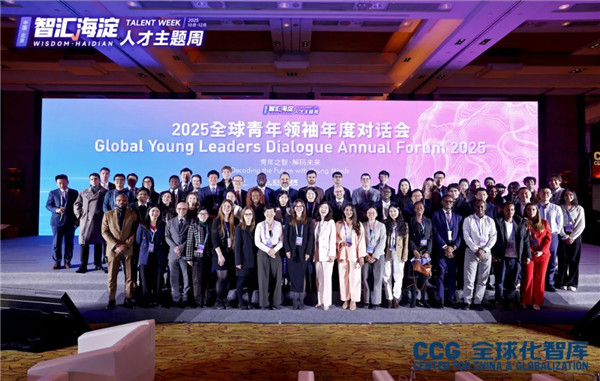
The Global Young Leaders Dialogue Annual Forum 2025 received nearly 300 applications from young professionals across more than 50 countries, from which nearly 30 outstanding Young Leaders were selected. These Young Leaders came from 23 countries, including Brazil, France, Italy, Malaysia, Mongolia, North Macedonia, Russia, Singapore, the United States, and Türkiye, among others. In addition to the young delegates, the forum also brought together senior experts from international organizations, government agencies, research institutions, and leading global enterprises. They gathered in Haidian to jointly explore the future of international cooperation driven by science, technology, and innovation.